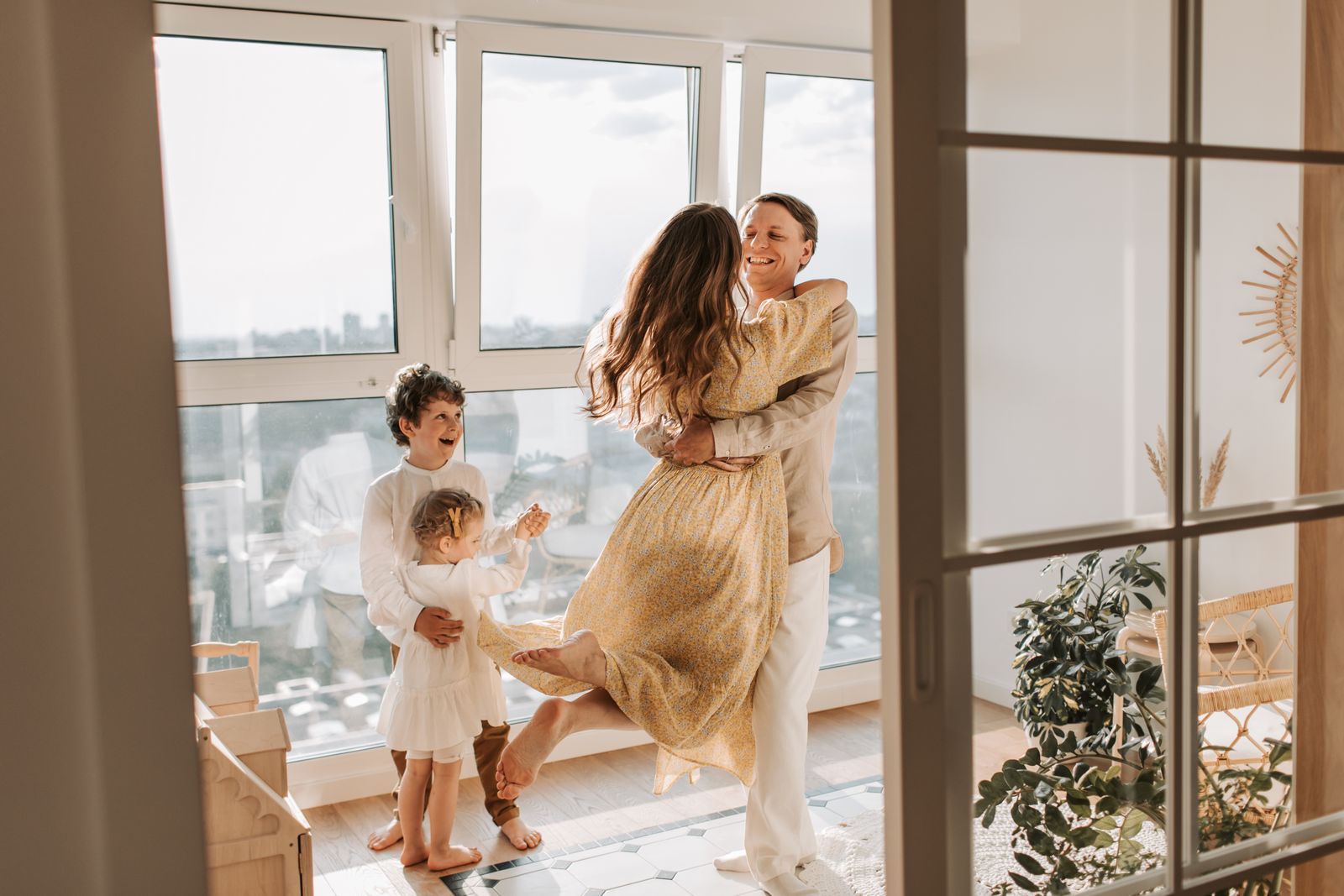
Six nights, four hotels, and a suitcase that never fully closed. That’s the trip a lot of families come home from, and it’s why slow travel with kids has quietly become the thing everyone’s booking instead. One rental. Two weeks. You unpack once.
The rental platforms have noticed. Vrbo runs a dedicated monthly-stays page now, Airbnb builds length-of-stay discounts straight into its pricing tools, and both start handing you money back the moment you cross seven nights.
The appeal isn’t philosophical, either. Moving a family is the expensive, exhausting part of travel, and doing it five times in ten days turns a holiday into logistics with a view. Here’s how to build the other kind.
What “one base for two weeks” actually means
You book one place for the whole stretch and treat it like an apartment, not a hotel room. Everything else radiates out from it: day trips, a market, a park you end up at four times.
Fourteen nights is the sweet spot, but the format works down to seven. Below about five nights you’re still in unpack-repack territory and the savings don’t kick in either.
The part that surprises people: you’ll see fewer things and remember more of them. A family that spends nine days in one Umbrian town comes home able to name the bakery. A family that does Rome-Florence-Venice-Milan in nine days comes home with a camera roll and a knot in everyone’s shoulders.
With kids under six, that trade is barely a trade. They weren’t going to remember the fourth cathedral anyway. What they remember is the man at the corner shop who started saving them the good bread.
The math: why 14 nights in one rental undercuts six hotel stays
Three separate things move in your favor at once, and none of them are obvious from the search page.
The length-of-stay discount. On both Airbnb and Vrbo, hosts can set a weekly discount that applies automatically at seven nights or more, and a monthly one at 28 nights or more. Two weeks lands you in weekly-discount territory, not monthly, which is the single most misunderstood thing about this format.
Worth knowing what you’re missing: Vrbo’s own monthly-stays page advertises an average saving of around 19% on select homes at 28-plus nights. Nobody hands you that for 14. So if a listing shows no weekly discount at all, message the host before you book and ask for one.
Airbnb hosts can answer a message with a special offer, a custom price that’s meant to cover all the nights and the cleaning fee. It expires in 24 hours, so don’t send that message the night before you want to book and then go to bed.
The cleaning fee, spread thin. A $150 cleaning fee is $75 a night across a two-night stay. Across fourteen nights it’s about $11. Same fee, completely different sting, and it’s the reason short rental stays so often price worse than hotels while long ones don’t.
The kitchen. Even a modest café breakfast for four adds up fast, and in a US or Western European city it’s routinely the difference between a $0 morning and a $50 one. Fourteen breakfasts of cereal, yogurt and fruit from a grocery store cost a fraction of that, and they happen at 6:40 a.m. in pajamas instead of at a table where somebody has to behave.
How to pick a base that actually works with kids
Listing photos are useless for this. What you want is boring infrastructure, and most of it is answerable from the listing text and one message to the host.
- Working smoke and carbon monoxide alarms. Hotels are under fire code; a private rental often isn’t. Airbnb encourages alarms and asks hosts to say whether they’re installed, so filter for both and ask outright if the listing is silent.
- A washing machine in the unit. Not “laundry nearby.” This one amenity is what lets you pack for five days instead of fourteen.
- Groceries within a ten-minute walk. Ask the host to name the shop. “There’s a supermarket close by” and “the Carrefour is 200 metres left out of the door” are different answers.
- A park or playground you can reach without a car. This is your 4 p.m. release valve, every single day.
- Real information about stairs and windows. A fourth-floor walk-up in a European building is a different trip with a stroller. Ask how many flights, whether there’s a lift, and what the windows do: full-height casements, a balcony, guards or stops, locks.
- A residential street, not the old town. Cheaper, quieter at 9 p.m., and the neighbors have kids.
- Free cancellation as far out as you can get it. Fourteen nights is a long time to be stuck somewhere wrong.
Two bedrooms beats one, and it beats it by more than the price difference suggests. In a single room, everyone’s evening ends when the toddler’s does; in a two-bedroom you get the couch back at 8 p.m. for fourteen nights running.
One caveat on that. The AAP asks that a baby sleep in the parents’ room, on their own separate surface, for at least the first six months. At that stage the second bedroom is for the older kids, not the baby.
The 90-minute rule for day trips
Here’s the rule we’d hold to: nothing more than 90 minutes from the front door, each way. Beyond that you’re not on a day trip, you’re on a small second holiday, and it will cost you the following morning.
Plan four excursion days out of fourteen. Four. That number looks absurdly low written down and feels about right by day nine.
Alternate them: out day, home day, out day, home day. A home day isn’t a wasted day. It’s the market, a long lunch, and the nap that makes tomorrow’s castle survivable.
Book the excursions that need tickets before you fly, and leave the rest genuinely empty. The best day of a two-week trip is almost never on the itinerary.
What two weeks in one place does to a kid
Somewhere around day four, something shifts. The kid who cried in the airport starts leading the way to the bakery. They know which drawer the spoons are in.
That’s not sentiment, it’s just how small children handle new places: they need repetition before they can relax into one. A week of one hotel a night never gives them that, which is why the meltdowns on fast trips seem to escalate rather than settle.
Naps get easier too, because the room stops being novel. Same cot, same blackout situation, same 1 p.m. Nothing fancy, just the fourteenth repetition of the same thing.
If you’re crossing time zones, the length works for you. CDC’s 2026 Yellow Book puts the average rate of adjustment at about an hour a day flying east and an hour and a half flying west, for travelers generally rather than children specifically. A six-hour change is therefore most of a seven-day trip and only the warm-up on a fourteen-day one. Our guide to jet lag with kids has the day-by-day version.
Pack for five days, not fourteen
This is the payoff for insisting on the washing machine. Five outfits per kid, one wash mid-week, done. A family of four can genuinely do two weeks in Europe out of two checked bags and a couple of backpacks.
Bring a small bag of laundry pods rather than counting on the cupboard, and check whether the machine is a washer-dryer combo. A combo can take two to four hours to wash and dry a single load and things often still come out damp, so start it in the morning, not at 9 p.m.
What does deserve the space: anything you’d struggle to buy in an unfamiliar pharmacy at 11 p.m., and whatever your kid actually sleeps with. Our family vacation packing list covers the rest.
The safety sweep a rental needs and a hotel doesn’t
Hotels are institutionally childproofed to a low but predictable standard. Somebody’s home is not. Fourteen nights is long enough that this matters, and the sweep takes about ten minutes on arrival.
Alarms first. Press the test button on the smoke and carbon monoxide alarms the night you arrive, and walk the exit route once with the kids. This is the biggest gap between a rental and a hotel and it takes four minutes.
Then water. Airbnb requires hosts to disclose safety hazards inherent to a listing and gives a pool or a body of water as its own example, but the level of detail is the host’s choice. An empty safety section is not proof there’s no water, so read it and then ask outright: is there a pool, hot tub, pond, canal or unfenced drop on or beside the property, and what stands between it and the door?
Ask because the stakes are high. Drowning is the leading cause of death for children aged one to four in the US, and most drownings in that age group happen in swimming pools.
A gate is a backup, not a plan. With a child under five near water, the plan is an adult within arm’s reach whose only job is that, handed over by name so nobody assumes someone else has it. Armbands, rings and puddle jumpers are toys rather than safety devices; if you want flotation, pack a US Coast Guard-approved life jacket in your child’s weight range, which folds flat and works at a pool, a lake or a boat dock.
Stairs. You can’t drill a hardware-mounted gate into someone else’s wall, and pressure-mounted gates aren’t built for the top of a staircase. CPSC’s childproofing guidance says only gates that screw into the wall belong there, and the federal gate standard requires pressure-mounted gates to carry a label saying so. They’re fine at the bottom of stairs or in a flat doorway; if you have a new walker, the honest fix is a rental on one level, or a stairwell door that closes and stays closed.
Windows and cords. Screens don’t stop falls, so keep upper-floor windows locked or stopped at under four inches and move every bed, cot and climbable chair to a wall without a window. Don’t knot or loop a blind cord to shorten it, and don’t assume out-of-reach is safe, because a child can pull a high cord down. CPSC puts it at about nine children under five killed by window covering cords each year, and of more than 200 recorded incidents involving children up to age eight, nearly half were fatal.
Sleep surface. Ask what the travel cot actually is, and use only the mattress or pad that came with it. Never add a topper, a folded quilt or an aftermarket play-yard mattress, because the gap that leaves against the mesh wall is a suffocation and entrapment hazard. Fitted sheet, nothing else in it, baby on the back for every sleep and nap through the first year, and a sofa or a made adult bed or a bed shoved against a wall is not a substitute.
One thing to skip: the little push-in plug caps. CPSC’s own criterion is that an outlet protector has to be too large for a child to choke on and hard for a child to pull out, which those fail on both counts. Sliding or self-closing outlet covers are the version worth packing, and dragging unanchored furniture in front of a socket is not a fix, since that’s a tip-over and a step-stool in one.
Watch out: the mid-trip slump is real
Around day eight or nine, somebody gets bored and somebody else gets irritable, usually the two adults. It’s not a sign you picked the wrong place. It’s just what two weeks in a small apartment does.
Plan for it rather than being surprised by it. Hold one good excursion in reserve for day nine, and split up for an afternoon: one parent takes the kids to the park or the market, the other sits somewhere with a coffee and speaks to nobody. Save the pool for when there are two adults.
The other real risk is a rental that’s wrong in a way photos hide, a road you can’t hear until 6 a.m. or a shower that trickles. Book cancellable, read the recent reviews rather than the glowing 2023 ones, and message the host with one specific question before you commit. How they answer tells you most of what you need.
Slow travel with kids: FAQ
Is two weeks in one place boring for kids?
Less than you’d think, and less than four cities in nine days. Children re-run the same playground happily for a fortnight; the adults get restless first. Four day trips and one genuinely new thing a week is plenty of structure.
How much cheaper is one two-week rental than hotel-hopping?
It varies too much to promise a number, but three things stack: a weekly discount that kicks in at seven nights on both Airbnb and Vrbo, a cleaning fee spread across fourteen nights instead of two, and breakfast made in a kitchen. The transport savings from not moving between cities are usually the biggest line of all.
What’s the minimum stay for slow travel to be worth it?
Seven nights, because that’s where the weekly discount starts on both platforms and roughly where kids settle into a place. Ten to fourteen is where it stops feeling like a holiday and starts feeling like living somewhere else for a bit.
Do we need a rental car for a two-week base?
Often no, and that’s part of the saving. If your base has groceries and a park within walking distance, hire a car for the four excursion days only rather than paying to park it for fourteen nights.
Bring your own car seat if you possibly can. Airlines check car seats free, and a rented seat arrives with no crash history, often no manual or expiry label, and nobody to help you fit it. If you do have to rent one, confirm the exact model in writing before you land, ask for the manual, and give yourself fifteen minutes in the car park to install it yourself.
Book the base, block out four days, and leave the rest of the calendar alone. That’s the whole method.


Leave a Reply