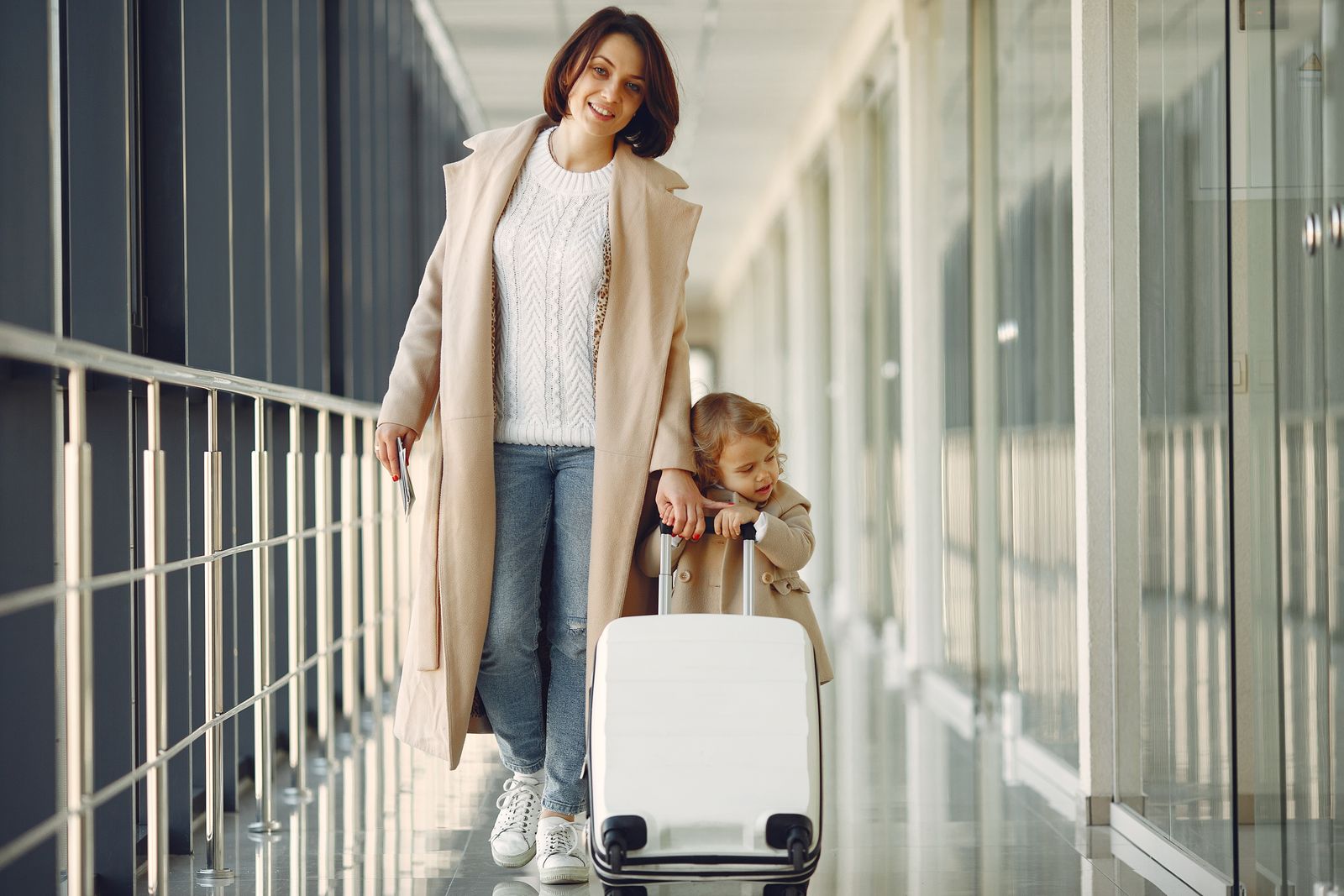
The board flips to DELAYED and your stomach drops before your brain catches up. There’s a four-year-old who has already asked for a snack twice, a gate agent about to be swarmed, and no way to tell if you’re leaving in an hour or tomorrow.
Here’s the thing about a flight delayed with kids: the first twenty minutes matter more than the next six hours. What you do while everyone else is still staring at the screen decides whether you spend the day rebooked and fed, or ninetieth in a line that isn’t moving.
So here’s what US airlines actually owe you in 2026, what they don’t, and how to get through the wait without burning every snack in the bag by 10 a.m.
Rebook two ways at once, before the line forms
Don’t choose between the app and the desk. Do both, starting now.
Open the airline app while you walk toward the gate podium. Most carriers push a self-rebook option the moment a flight is officially delayed past their threshold, usually as a banner on your boarding pass or under “Flight status.” Before you accept anything, check that it has kept your party together, because an automated rebooking will sometimes seat a child away from you and hand you the confirmation like nothing happened. If it can’t hold you together, back out and wait for a human. Otherwise take the seats even when the timing is ugly. You can improve on them later; you can’t un-lose four seats on the last flight out.
Then get in the podium line anyway, and call the airline’s phone number while you stand in it. Three attempts running in parallel, one of which lands first. On a bad weather day the phone queue often moves before the gate line does.
One adult in line, one adult with the kids somewhere with floor space, is the split that works. Flying solo with them? Stay in the podium line. Agents can pull up options the app won’t show you, and on an airline with interline agreements that can include seats on a different carrier.
What US airlines actually owe you in 2026 (and the one thing none of them give)
The Department of Transportation publishes a dashboard listing exactly what each large US carrier has committed to when a delay or cancellation is the airline’s own fault. It is the most useful page in American air travel and almost nobody opens it.
As the dashboard reads now, all nine airlines on it commit to rebooking you on their own flights at no extra cost, and to a meal or meal voucher once a controllable delay leaves you waiting three hours or more. Eight of the nine also commit to a free hotel for an overnight disruption plus ground transport to it. Frontier is the outlier on both.
Two more gaps are worth knowing before you book, not after. Frontier, Southwest, and Allegiant don’t commit to rebooking you on a different airline at all. If your carrier’s next open seat is Thursday and you needed Tuesday, that single line is the difference between a real flight and a rental car.
And the thing none of them give: cash. Not one US airline on the dashboard commits to cash compensation for a three-hour delay. If you’ve heard about travelers collecting hundreds for a delay, they were flying in Europe, and we’ll get to that.
“Controllable” is the word that decides your whole day
Every amenity above hangs on one word: controllable. A crew that timed out, a mechanical problem, an IT meltdown, a late inbound aircraft. That’s on the airline, and the meal voucher and the hotel are on the table.
A thunderstorm over Dallas is not. Airlines’ contracts of carriage generally carve out weather and air traffic control, and when they do, those commitments simply don’t apply. Plenty of agents hand out vouchers on a long weather night anyway, but you can’t demand one, and demanding it at a podium with two tired kids spends the only goodwill you have.
Ask instead. “Is this coded as controllable?” is a question agents answer straight, and the answer tells you in five seconds whether to expect a hotel or start pricing one yourself.
Then check your credit card. Trip-delay benefits on many travel cards do cover weather, and that’s the thing that reimburses a $180 airport hotel when the airline won’t. Thresholds vary a lot by card, commonly six hours or an overnight, and coverage almost always requires that you paid for the trip with that card. Read your own benefits guide before you pay, and keep every receipt.
Your refund is separate, and you get it even for weather
Refunds run on a completely different track from meals and hotels, and this is where families come out ahead.
Under the DOT’s automatic refund rule, if your flight is canceled or significantly changed and you decide not to take the replacement, you’re owed the full ticket price back regardless of the reason. Weather counts. “Significant” means three hours or more on a domestic flight, six hours or more on an international one.
It’s supposed to be automatic. You shouldn’t have to file anything, and it has to go back to your original form of payment rather than a voucher: seven business days for a credit card purchase, twenty calendar days for cash, check, or debit. Seat fees and bag fees you paid for a service you never received come back too.
One narrowing to keep an eye on: in July 2026 the DOT paused enforcement of the slice of the rule that covers flights merely given a new number rather than genuinely canceled, through July 2027, while it reworks that definition. The three-hour and six-hour refund rights above are untouched.
Watch out: the moment you accept a travel credit or voucher, the cash is gone. Agents offer vouchers first because vouchers are cheaper for the airline. If you’re going to drive, or book yourself onto another carrier, say no to the voucher and ask for the refund in writing.
Six hours in a terminal: food that holds up
Assume the meal voucher, if it comes at all, is modest, arrives as a code on your phone an hour after you needed it, and doesn’t stretch across four people. Airlines don’t publish the values. Feed the kids from your own bag first and treat the voucher as a bonus.
Security rules are unusually generous here. TSA exempts formula, breast milk, toddler drinks, and baby and toddler food, puree pouches included, from the 3.4-ounce liquid limit entirely, and they don’t have to fit in the quart bag. Ice, freezer, and gel packs to keep it all cold are allowed too, whether or not there’s milk with them. Tell the officer before screening starts and take those items out separately. TSA asks for clear, translucent bottles rather than bags or pouches, since pouches may not be readable by the bottle scanner and you may be asked to open them. And your child doesn’t have to be with you to bring breast milk or formula through.
Snacks are where a long delay quietly turns into a safety problem. The American Academy of Pediatrics’ guidance is to keep high-risk foods away from young children until at least age four, and longer than that depending on how well a particular child chews and sits still to eat. Hour five at a gate is not where you want to be making a borderline call.
The foods AAP flags to avoid or modify include whole grapes, popcorn, hard candy, nuts and seeds, hot dogs, meat sticks and sausages, chunks of meat, chunks of cheese and string cheese, raw carrot and other raw vegetable sticks, marshmallows, chewing gum, and thick globs of nut butter. Most of them can still travel with you if you cut everything into pieces no larger than half an inch and everyone eats sitting down, which is the part that stops happening around hour four.
For kids past that stage, the snacks that survive six hours in a terminal are the boring ones: crackers, applesauce pouches, a banana, a sandwich. Refill water bottles past security rather than buying them, too. Four bottles at $4 each, twice over a long delay, is $32 you’d rather spend on dinner.
Where to put a toddler for six hours
The gate area is the worst place in the airport to wait out a delay with a small child, and nothing requires you to sit in it.
Pull up your airport’s own “children and families” page while you’re sitting there. It’s the fastest way to learn whether there’s a play area and exactly where. Denver, for instance, has two free play areas open 24 hours a day, near Gate C54 and near Gate A25, plus nursing rooms on every concourse. Plenty of large airports have something similar, and a few have quietly closed theirs, which is precisely why you check the airport’s own site instead of an old listicle.
No play space? Find an empty gate. A gate whose flight departed an hour ago has rows of seats, clear floor, and outlets nobody is fighting over. Run your charging cords behind you rather than across the patch of floor the kids are using, and take thirty seconds to look at what’s within reach at their height before you settle in.
Escalators get their own rule. Strollers never go on one, so take the elevator every time, even when it’s three minutes out of the way. When you do ride an escalator with a walking child, hold the hand, keep them off the sides of the steps where feet get caught, and know that soft-soled shoes and flip-flops are the ones that get pulled in. Moving walkways are a different animal and strollers are generally fine on them; the hazard there is a kid treating it like a treadmill.
Keep the departure board in view rather than the gate agent. Gate changes during a delay are common, and the app usually knows before the announcement does.
When it turns into an overnight
Once a delay tips into an overnight, three things need sorting, in this order: where you’re sleeping, where your car seat is, and where the baby is sleeping.
If it’s controllable, ask for the hotel and the ground transportation in the same breath. Eight of the nine airlines on the DOT dashboard commit to both, but they’re issued separately and agents sometimes hand over only one.
The car seat is what families forget. Gate-checked, it comes back at the jet bridge; checked at the counter, it’s in the bag system and may not come off the aircraft at all. Ask at baggage services before you leave the secure area, not after.
You need that seat for the ride to the hotel, and a five-minute ride is not a reason to skip it. One wrinkle worth planning around: some hotel shuttles are high-capacity vans or buses where the belts won’t take a car seat properly. If that’s what pulls up, ask the hotel or the airline for a car service, or take a rideshare you can actually install in. And look the seat over before you use it. Manufacturers say a car seat that’s been damaged shouldn’t be used, and a rough trip through a bag system is exactly how that happens.
Then the baby, and this is where a long night quietly goes wrong. A baby who falls asleep in a car seat, stroller, swing, or carrier should be moved to a firm, flat sleep surface on her back as soon as possible. AAP’s wording is “as soon as possible,” not as soon as it’s convenient, and it matters most under four months, when a slumped airway is the risk.
Ask for a crib or play yard when the room is booked rather than at the front desk at 1 a.m. When it arrives, check it: no missing or loose parts, nothing inside it but the manufacturer’s own mattress and a fitted sheet, and move it clear of lamp cords, blind cords, and anything that could fall in. If it never shows up, call down again instead of defaulting to the bed. Room-share, don’t bed-share.
And if you’re stuck airside with no crib at all, be honest with yourself: there’s no good improvised bed. AAP is clear that infant sleep belongs in a crib, bassinet, portable crib, or play yard meeting CPSC standards, with blankets kept out of the sleep space, so don’t build something on the terminal floor. Keep her upright in a carrier with her face visible and her chin off her chest, with an awake adult watching her, and swap that adult out before you’re too tired to be the one watching.
Flying home from Europe? Those rules actually pay
If your delayed flight departs an airport in the EU, or is operated by an EU carrier flying into the EU, you’re covered by EU261, and EU261 pays cash.
Land at your final destination three or more hours late and compensation is set by distance: €250 for flights up to 1,500 km; €400 for flights of 1,500 to 3,500 km, and for any flight within the EU over 1,500 km however long it is; €600 above 3,500 km. It’s per passenger, and a child with their own paid seat counts exactly like an adult.
One catch families hit constantly: on flights over 3,500 km the airline is allowed to halve the payment when you land less than four hours late. A transatlantic flight arriving three and a half hours behind pays €300 a head, not €600. Cross the four-hour line and it’s the full amount. So four paid seats on a delayed transatlantic flight is €1,200 or €2,400 depending on which side of four hours you land, and that’s the one place where how late you were, not just how far you flew, decides the money.
The lap infant is its own puzzle. The regulation excludes passengers “travelling free of charge,” but the European Commission’s own guidance says a fare reduced to zero doesn’t count as free if you still paid taxes and charges to get the ticket, which on a transatlantic infant booking you almost certainly did. Check the receipt before you assume the baby isn’t covered, and file either way. The worst outcome is a no.
Extraordinary circumstances, which covers most weather and air traffic control strikes, wipe out the cash compensation. The airline still owes you meals and a hotel while you wait, though. That duty of care survives even then.
Planning further ahead? The EU adopted a reform package in July 2026. The three-hour threshold and the €250 to €600 amounts survived it, children under 14 gain a right to sit beside an accompanying adult at no charge, and pushchairs get carried to the aircraft door free. But infants under two travelling free, or on a fare the public can’t book, lose the compensation right outright. The new rules aren’t expected to apply until summer 2027.
How to stack the odds before you ever book
You can’t prevent a delay. You can make one much less likely to swallow the whole trip.
- Book the first flight of the day. DOT’s own Air Travel Consumer Report puts on-time performance at the 30 largest US airports at roughly 93% for 6 a.m. departures, sliding to about 78% by the 8 p.m. bank. Delays compound through the day, and the early flights have almost nothing upstream of them.
- Give connections real time. A 45-minute legal connection is fiction with a stroller, a diaper change, and a terminal change. Ninety minutes domestically and two hours internationally is what actually works with kids.
- Prefer an airline that can rebook you elsewhere. A carrier with interline agreements can hand you to another airline. One without can only offer you its own next seat, which on a holiday weekend might be two days out.
- Pack the carry-on as if the delay will happen. A full change of clothes per kid, a full extra day of diapers, all medications, and the comfort object.
Our family vacation packing list has the full breakdown, and if this is your first flight with a little one, flying with a toddler for the first time covers the parts a delay only makes louder. The rule of thumb: anything that would ruin your night if it were in the belly of the plane goes on your back.
FAQ
Do US airlines have to pay compensation for a delayed flight?
No. There’s no US law requiring cash compensation for a delay, and not one airline on the DOT’s cancellation and delay dashboard has voluntarily committed to it either. What they do commit to, when the delay is their own fault, is rebooking and a meal after three hours, and for eight of the nine a hotel overnight.
What am I owed if the delay is weather?
A refund, if the flight is canceled or pushed three-plus hours domestically and you choose not to fly. That right doesn’t care about the cause. Meals and hotels usually do: most contracts of carriage exclude weather, so those become a courtesy rather than an entitlement. Your credit card’s trip-delay benefit is often what actually covers the hotel.
Can the airline split my family up when it rebooks us?
It can happen, especially on an automated rebooking. Five US airlines guarantee on the DOT’s family seating dashboard that a child 13 or under sits next to an accompanying adult at no extra cost, subject to conditions like everyone being on one reservation: Alaska, American, Frontier, Hawaiian, and JetBlue. Delta, United, Southwest, and Allegiant have not made that commitment, so say it out loud to the agent: “I have a four-year-old, we need to be together.”
How long does a flight refund take?
Seven business days back to a credit card, twenty calendar days for cash, check, or debit, and it should arrive without you filing anything. If it hasn’t landed by then, or the airline hands you a voucher you never agreed to, you can file a complaint with the DOT’s aviation consumer protection office.
A delay is a bad afternoon, not a ruined trip. Rebook fast, feed everyone early, find the floor space, and know what to ask for. The rest is just waiting, and kids are better at waiting than we give them credit for when somebody’s already handled the hard parts.



Leave a Reply